Waterless by Design: Eliminating or Drastically Reducing Water Consumption at an Existing Datacenter Campus

A Technical White Paper on Sustainable Cooling Architecture, Advanced Liquid Cooling, Water Reclamation, and Architectural Redesign for the Modern Hyperscale Datacenter
The Problem Hidden in Plain Sight
Every time a server processes a request, it generates heat. Every time that heat must be removed, a conventional datacenter campus reaches for the same tool it has relied upon for decades: water. Cooling towers evaporate it, chillers circulate it, humidification systems inject it into the air, and emergency scrubbers consume it. Water has been so deeply embedded in the datacenter cooling paradigm that most facility operators never question whether it needs to be there at all.
The answer, supported by an increasingly large and credible body of engineering data, field deployments, and architectural research, is that water does not need to be there. It is not a physical necessity of datacenter cooling. It is a legacy design choice, one inherited from an era when water was cheap, climate conditions were stable, municipal supplies were reliable, and nobody tracked Water Usage Effectiveness as a key performance indicator. That era is over.
Texas alone hosts more than 400 datacenter facilities concentrated across five regions: the Dallas and Fort Worth area with 197 facilities, Houston with 48, Austin with 53, and West Texas with 59, with additional significant concentrations in other major metropolitan areas. Collectively, those facilities consume approximately 25 billion gallons of water per year as of 2025. By 2030, the Electric Reliability Council of Texas forecasts that datacenter electricity demand could increase nearly tenfold, to 77,965 megawatts, an increase of 83 percent over current demands. If water intensity tracks that growth, Texas datacenters alone could consume between 29 and 161 billion gallons annually by the end of the decade, representing up to 2.7 percent of the entire state's water budget.
This is not a distant forecast. It is an engineering emergency unfolding in real time, in a state where over 80 percent of the land area was already experiencing drought conditions as of April 2025, with 17 percent classified as exceptional drought. Cities across the American Southwest have already watched their combined reservoir capacities collapse to crisis levels, crises driven by industrial water commitments made against a rainfall baseline that climate change has fundamentally invalidated.
This article is a comprehensive technical guide for datacenter campus operators, facilities engineers, infrastructure architects, and sustainability leaders who are ready to answer a direct question: What can we do, starting now, to eliminate or drastically reduce the amount of water our campus consumes? The answer is structured across nine major intervention categories, each examined with the depth and specificity that a problem of this magnitude demands. Real world case studies are included to demonstrate that these strategies are not theoretical. They are operational, proven, and commercially viable today.
Part One: Understanding What You Are Actually Consuming
Before any reduction strategy can be implemented, operators must understand the full scope of water consumption across their campus. This is more complex than reading a single utility meter.
Direct Water Consumption Categories
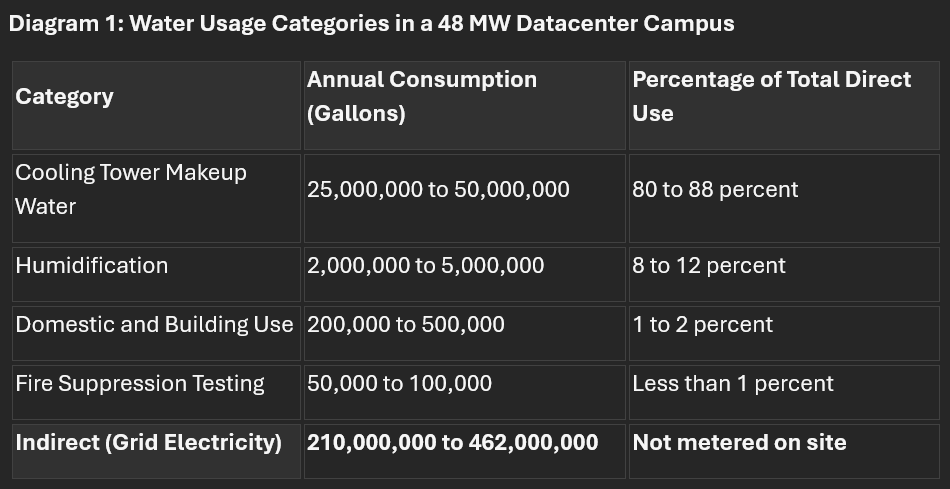
A typical large datacenter campus consuming 48 megawatts of IT load will draw water from several distinct subsystems. The first and largest category is cooling tower makeup water. Cooling towers reject heat through evaporation, drift, and blowdown. A conventional cooling tower system at a 48 megawatt facility operating in a hot climate, where ambient temperatures routinely exceed 100 degrees Fahrenheit in summer, will evaporate between 25 and 50 million gallons of water per year. This figure scales with the number of hours per year the mechanical cooling system must operate and with the ambient wet bulb temperature. In hot, humid climates, where wet bulb temperatures frequently reach 78 to 82 degrees Fahrenheit during summer afternoons, evaporative cooling is the most thermally efficient option available but also the most water intensive.
The second category is humidification. Datacenters must maintain relative humidity between 40 and 60 percent per ASHRAE Standard TC 9.9 recommendations to prevent electrostatic discharge and corrosion. In dry climates, achieving this requires injecting water vapor into the air supply. A 48 megawatt facility in an arid environment may consume 2 to 5 million gallons per year on humidification alone, a figure that is frequently overlooked in water audits.
The third category is domestic water for the building: restrooms, cafeterias, eyewash stations, fire suppression system testing, and landscaping irrigation. While individually modest, these uses add up across a large campus to several hundred thousand gallons per year.
The fourth and most underappreciated category is indirect water consumption from electricity generation. If a datacenter draws power from a grid supplied primarily by coal or natural gas plants, those thermoelectric generators consume enormous quantities of water for steam production and cooling. The Department of Energy estimates that coal plants consume between 0.5 and 1.1 gallons of water per kilowatt hour of electricity generated, while natural gas combined cycle plants consume between 0.1 and 0.3 gallons per kilowatt hour. A 48 megawatt facility operating at full load for 8,760 hours per year consumes approximately 420,480 megawatt hours annually. At a coal heavy grid intensity, that translates to between 210 million and 462 million gallons of indirect water consumption per year, dwarfing the direct cooling water use by a factor of 10 or more.
The Water Usage Effectiveness Metric
Water Usage Effectiveness, commonly abbreviated as WUE, is the primary metric for evaluating datacenter water efficiency. It is calculated by dividing the total annual volume of water used for cooling and humidification, measured in liters, by the total annual energy consumed by IT equipment, measured in kilowatt hours. The result is expressed in liters per kilowatt hour.
A traditional datacenter campus relying on evaporative cooling towers in a hot climate will typically carry a WUE between 1.5 and 2.5 liters per kilowatt hour. The industry's most advanced closed loop liquid cooled facilities are now reporting WUE values of approximately 0.30 liters per kilowatt hour or below. The theoretical minimum WUE for a fully dry cooled facility, one that uses no evaporative processes whatsoever, approaches zero, limited only by small quantities of water needed for initial system fill and periodic maintenance top offs.
The goal articulated in this article is to move a campus from a WUE of 1.5 to 2.5 down to below 0.10, and in the most aggressive implementations, to a WUE that is effectively zero for all practical reporting purposes.
Part Two: The Foundation Strategy, Eliminating Evaporative Cooling
The single most impactful change any datacenter campus can make is the elimination of evaporative cooling as the primary heat rejection mechanism. This is not a marginal improvement. It is a structural transformation that, by itself, can eliminate 80 to 99 percent of direct water consumption.
Understanding Why Evaporative Cooling Dominates Today
Evaporative cooling is thermally efficient in hot climates because it leverages the latent heat of vaporization of water. When one pound of water evaporates, it absorbs approximately 970 British Thermal Units of heat. This makes it dramatically more effective at heat rejection per unit of air movement than sensible cooling alone. A cooling tower can reject heat at an outdoor temperature of 100 degrees Fahrenheit as long as the wet bulb temperature is significantly lower, because the cooling is limited by wet bulb temperature rather than dry bulb temperature. In South Texas, wet bulb temperatures average 10 to 20 degrees Fahrenheit lower than dry bulb temperatures, giving evaporative systems a meaningful thermodynamic advantage.
This advantage, however, comes at the direct cost of water. The water that evaporates is gone, consumed, returned to the atmosphere rather than to the municipal water supply or any recoverable source. At an industry standard of 4 to 6 cycles of concentration before blowdown, approximately one sixth of all makeup water is lost directly to blowdown, in addition to the water lost to evaporation and drift. An industry standard cooling tower at a 48 megawatt facility may process between 500 and 1,000 gallons per minute during peak summer operation.
Dry Air Cooled Chiller Systems
The most direct replacement for evaporative cooling towers is the air cooled chiller. An air cooled chiller rejects heat entirely through sensible heat transfer, meaning it passes air across refrigerant coils and exhausts the heat to the atmosphere without any water evaporation. The refrigerant cycle absorbs heat from the chilled water loop serving the datacenter's cooling infrastructure and then rejects it through air cooled condensers on the roof or in the yard.
The tradeoff is thermodynamic: air cooled chillers are limited by dry bulb temperature rather than wet bulb temperature. In hot climates, where July dry bulb temperatures average 97 degrees Fahrenheit and regularly exceed 104 degrees Fahrenheit, an air cooled chiller must reject heat against a significantly higher ambient temperature than a cooling tower would face. This reduces the chiller's coefficient of performance, meaning it consumes 20 to 35 percent more electricity per ton of cooling delivered.
However, the elimination of water consumption is total. An air cooled chiller system, properly sized and maintained, consumes essentially zero water for cooling. Over the course of a year, the energy penalty of 20 to 35 percent additional electricity consumption must be weighed against the complete elimination of 25 to 50 million gallons of annual water consumption. In regions where water costs are rising, where drought surcharges are imposed, or where water availability is restricted by Stage 3 or Stage 4 drought contingency plans, the financial case for air cooled chillers strengthens considerably year over year.
A 48 megawatt facility with a legacy WUE of 2.0 liters per kilowatt hour consuming approximately 29 million gallons of water per year, at a fully burdened cost of water including sewer charges and chemicals of approximately 3.00 dollars per thousand gallons, spends roughly 87,000 dollars per year on cooling water in direct charges alone. That figure understates the true cost because it excludes the cost of water treatment chemicals, the labor and maintenance costs of cooling tower operation, the capital cost of cooling tower replacement every 20 to 25 years, and the regulatory risk of operating a major water consumer during drought restrictions. When those factors are included, the total cost of water in a traditional evaporative system at a large campus can exceed 500,000 dollars per year.
Adiabatic Pre Cooling as a Transitional Hybrid
For facilities in hot climates where the performance penalty of pure air cooled chillers is a concern, adiabatic pre cooling offers a proven hybrid path. An adiabatic cooler uses a small quantity of water to evaporatively pre cool the air entering an air cooled heat exchanger. Rather than evaporating water directly into the process stream as a cooling tower does, the adiabatic cooler sprays or drips water onto evaporative media through which the incoming air passes. The air is cooled by 10 to 20 degrees Fahrenheit before it contacts the refrigerant coils, improving the heat rejection performance of the air cooled system substantially.
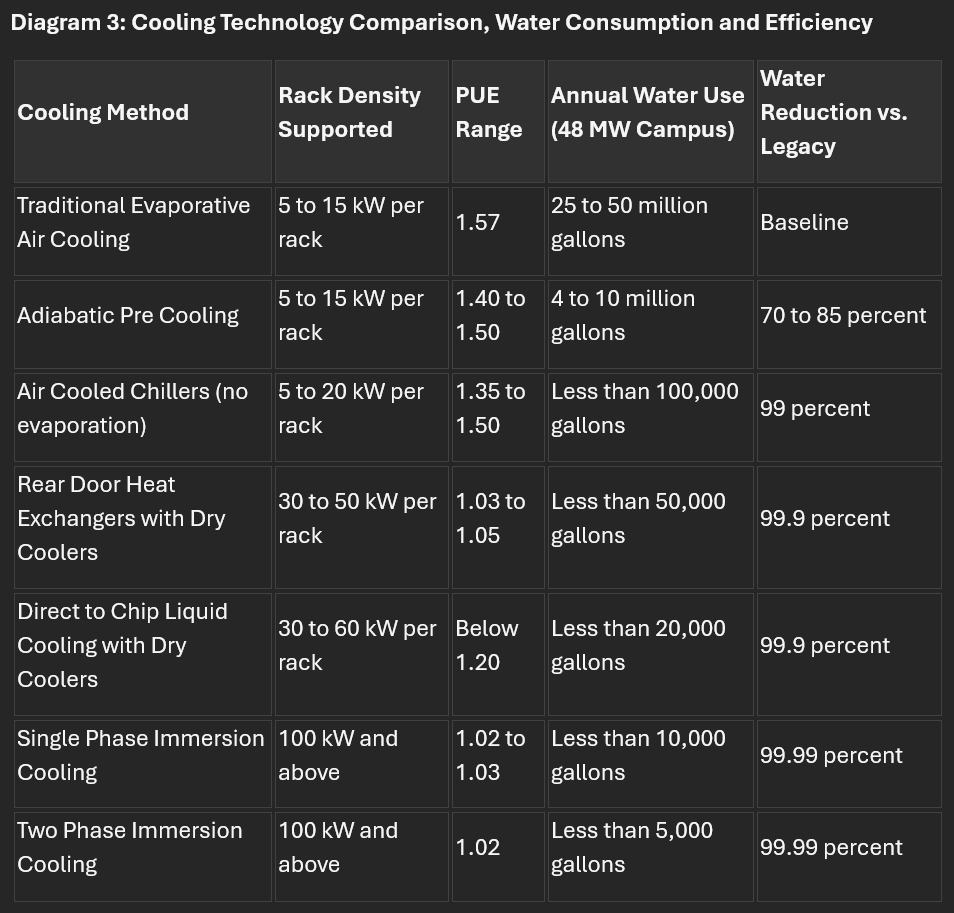
Critically, adiabatic pre cooling is used only during the hours when ambient temperature exceeds a threshold, typically around 75 degrees Fahrenheit dry bulb. In a hot inland climate, temperatures exceed that threshold for approximately 3,000 to 4,000 hours per year. During the remaining 4,760 to 5,760 hours, the system operates in dry mode with zero water consumption. The net result is a water consumption reduction of 70 to 85 percent compared to a full evaporative cooling tower system, with minimal performance penalty compared to a pure air cooled chiller during peak summer operation.
A campus transitioning from full evaporative cooling to adiabatic pre cooling can expect to reduce water consumption from 25 to 50 million gallons per year down to approximately 4 to 10 million gallons per year, with further reductions achievable through optimization of the pre cooling activation threshold. The capital cost of adiabatic retrofits is moderate, typically ranging from 500,000 to 2 million dollars for a 48 megawatt campus, with a payback period of 3 to 7 years depending on local water costs and drought surcharge exposure.
Part Three: Free Air Economization and Outdoor Air Cooling
The second major pillar of water reduction is the aggressive expansion of free air economization, the practice of using outdoor air directly for cooling when ambient conditions permit. This approach is not new, but most facilities in hot climates underutilize it due to conservative design assumptions, outdated ASHRAE inlet temperature standards, and legacy equipment that cannot take full advantage of expanded temperature envelopes.
The ASHRAE Temperature Envelope and Why It Matters
ASHRAE Standard TC 9.9 defines four thermal classes for datacenters. Class A1 covers the narrowest temperature range, with recommended inlet temperatures between 64 and 80.6 degrees Fahrenheit. Class A2 extends the recommended range to 95 degrees Fahrenheit. Classes A3 and A4 allow inlet temperatures up to 104 and 113 degrees Fahrenheit respectively, with certain humidity conditions.
Most datacenter campuses were designed for Class A1 or A2, meaning they activate mechanical cooling whenever outdoor temperatures rise above approximately 65 to 70 degrees Fahrenheit. A Class A1 facility in a moderate climate can therefore economize for approximately 40 to 46 percent of annual operating hours, consuming zero water during those periods.
However, server hardware has advanced significantly since most of these facilities were designed. Modern enterprise servers from major manufacturers are routinely qualified to Class A2 and many to Class A3 temperatures. By expanding the economizer activation setpoint from 65 to 77 degrees Fahrenheit, a facility can increase its economization hours from approximately 3,500 to nearly 5,500 hours per year. That additional 2,000 hours per year of water free cooling represents a 23 percent improvement in annual water reduction for no capital investment beyond a control system software update and a server inlet temperature audit.
For every hour of free air economization that replaces mechanical cooling, a 48 megawatt facility eliminates approximately 2,400 to 3,600 gallons of cooling tower makeup water, based on typical evaporation rates for a facility of that size. At 5,500 economization hours per year, that represents the elimination of 13 to 20 million gallons of annual water consumption from economization alone.

Part Four: Closed Loop Liquid Cooling, The Transformation of How Heat Is Removed
The most structurally significant shift in datacenter cooling technology is the transition from air cooling to closed loop liquid cooling. This shift does not merely reduce water consumption. It fundamentally changes the relationship between the datacenter and water, transforming water from a consumable input into a durable infrastructure component that is filled once and recirculated indefinitely.
How Closed Loop Systems Eliminate Water Consumption
A traditional evaporative cooling system is an open loop. Water is drawn from a municipal supply, pumped through a cooling tower where a portion of it evaporates into the atmosphere, and the remainder is periodically discharged as blowdown to prevent mineral buildup. This is a continuous consumption process. The water that evaporates is gone.
A closed loop liquid cooling system is fundamentally different. The coolant, which may be water, a propylene glycol and water mixture, or a synthetic dielectric fluid, is sealed inside a piping network that never contacts the atmosphere. Heat is absorbed from servers by the coolant as it flows through cold plates, rear door heat exchangers, or immersion tanks. The heated coolant then travels to a dry cooler or air cooled heat exchanger on the building exterior, where it rejects heat to the atmosphere through sensible heat transfer, not evaporation. The cooled coolant then recirculates back to the servers. The system is filled once at commissioning and requires only small makeup additions to replace losses from minor leaks or maintenance activities.
The water consumption of a properly maintained closed loop system at a 48 megawatt campus is approximately 5,000 to 20,000 gallons per year for makeup, compared to 25 to 50 million gallons per year for an evaporative system. This represents a reduction of 99.9 percent or greater.
Direct to Chip Liquid Cooling
Direct to chip liquid cooling, also referred to as cold plate technology, is the most widely deployed form of closed loop liquid cooling in hyperscale datacenter environments today. The system consists of metal cold plates, typically machined copper or aluminum, mounted directly on the top surface of CPUs, GPUs, and other high heat generating components. Coolant flows through microchannels within the cold plate, absorbing heat at the source before it can dissipate into the surrounding air.
The thermodynamic advantage is substantial. The thermal resistance between a server chip and a cold plate is orders of magnitude lower than the thermal resistance between the same chip and a stream of moving air. This means that the coolant can be delivered at a significantly higher temperature, typically between 65 and 85 degrees Fahrenheit, while still maintaining the chip at safe operating temperatures. Because the coolant arrives warm rather than cold, it can be cooled on the rejection side by a dry cooler operating against outdoor air temperatures, rather than requiring refrigeration. In a hot climate, a dry cooler can effectively reject heat from a 75 degree Fahrenheit coolant supply for approximately 6,000 to 7,000 hours per year, during which time no refrigeration compressor operates and no water evaporates.
Direct to chip cooling, when combined with dry heat rejection systems, reduces datacenter water consumption by 80 to 90 percent while simultaneously reducing energy consumption by 20 to 30 percent compared to equivalent air cooled systems. For a 48 megawatt campus, this translates to annual energy savings of approximately 47,000 to 70,000 megawatt hours per year in addition to the near total elimination of cooling water consumption.
Rear Door Heat Exchangers
For brownfield facilities where full direct to chip conversion is not immediately feasible, rear door heat exchangers provide a practical and rapidly deployable intermediate option. A rear door heat exchanger replaces the standard vented rear door of a server rack with a door containing a closed loop heat exchanger coil. As hot air exits the rear of the server rack, it passes through the heat exchanger and is cooled before entering the return air plenum of the datacenter. The heated coolant is then pumped to a dry cooler or air cooled chiller for heat rejection.
Rear door heat exchangers can be retrofitted onto existing racks without any modification to the servers themselves, making them the lowest barrier entry point into closed loop liquid cooling. They support rack densities up to 30 to 50 kilowatts and regularly achieve Power Usage Effectiveness values between 1.03 and 1.05 in operational deployments. The water consumption of a rear door heat exchanger system connected to a dry cooler is essentially zero, limited only to makeup water for the closed loop.
A campus deploying rear door heat exchangers on 50 percent of its racks can reduce its overall cooling water consumption by 40 to 60 percent within a single fiscal year, at a capital cost of approximately 2,000 to 5,000 dollars per rack plus the cost of the dry cooler infrastructure.
Single Phase Immersion Cooling
Single phase immersion cooling represents the most thermally comprehensive form of closed loop liquid cooling commercially available. In a single phase immersion system, entire server boards are submerged in tanks filled with a dielectric fluid, a specialized synthetic liquid that does not conduct electricity. The fluid absorbs heat directly from every component on the server board, including processors, memory modules, voltage regulators, and storage devices. The heated fluid is pumped through an external heat exchanger where heat is rejected to a dry cooler, and the cooled fluid returns to the immersion tank.
Because the fluid contacts every component directly, thermal resistance is minimized to a degree impossible in any air cooled or even cold plate system. Immersion cooling can support rack power densities exceeding 100 kilowatts, levels that are completely unachievable with air cooling and extremely challenging even for direct to chip systems. The elimination of server fans reduces server power consumption by 10 to 15 percent. Single phase immersion systems have demonstrated Power Usage Effectiveness values as low as 1.02 to 1.03 in operational deployments, representing the most efficient thermal management technology commercially available.
The dielectric fluid in a single phase immersion system does not evaporate under normal operating conditions. The system is sealed, the fluid recirculates indefinitely, and water consumption is zero beyond the dry cooler side of the heat exchanger.
Two Phase Immersion Cooling
Two phase immersion cooling uses a dielectric fluid with a boiling point near 122 degrees Fahrenheit. When hot server components heat the fluid to its boiling point, the fluid vaporizes. The vapor rises to a condenser coil mounted above the fluid level, where it condenses back to liquid and falls back into the tank. This passive phase change cycle, which requires no pumps, achieves the most efficient possible heat transfer, exploiting the latent heat of vaporization of the dielectric fluid rather than relying solely on sensible heat transfer.
The technology can achieve Power Usage Effectiveness values approaching 1.02, and because the condenser can be cooled by relatively warm water, typically between 95 and 115 degrees Fahrenheit, the rejection side can use a dry cooler operating effectively even in moderately warm ambient conditions. Water consumption is zero. The fluid, which costs approximately 50 to 100 dollars per liter, is sealed inside the system and is not consumed.
Part Five: Architectural Redesign to Enable Dry Cooling
One of the most important and underappreciated insights in datacenter water reduction is that cooling water consumption is not purely a function of cooling technology. It is also a function of architectural efficiency. A poorly designed datacenter floor, with long airflow paths, hot and cold air mixing, bypass air, and recirculation, requires far more cooling energy and far more aggressive heat rejection than a well designed one. This excess cooling demand is what forces facilities to rely on water intensive evaporative systems even in climates where dry cooling should theoretically be adequate.
The Problem With Legacy Rectangular Layouts
Traditional datacenter COLO halls are rectangular rooms with server racks arranged in long parallel rows. Cold air is supplied from raised floor tiles and hot air is returned through overhead plenums or ceiling return ducts. In a well managed facility with proper aisle containment, this works adequately. In a typical operational facility, it works poorly.
Three well documented failure modes characterize legacy rectangular layouts. The first is recirculation, where hot exhaust air from server rack rear outlets bypasses the return plenum and reenters server rack front intakes, forcing the cooling system to deliver supply air at a lower temperature to compensate, which in turn requires more refrigeration energy and more evaporative cooling. The second is bypass air, where chilled air flows from supply tiles into the return plenum without passing through any server rack at all, wasting cold air while reducing effective cooling capacity. The third is stratification, where temperature gradients form vertically within the room, with hot air pooling near the ceiling and cold air sinking to the floor, forcing cooling setpoints below what would otherwise be necessary and increasing both energy and water consumption.
Cooling systems in traditional rectangular layouts consume 30 to 40 percent of total facility energy, yielding a Power Usage Effectiveness of approximately 1.57. The excess cooling energy above what an optimized design would require translates directly into excess water consumption. Fixing the architectural root cause of that excess is therefore a water reduction strategy as much as an energy reduction strategy.
The Concentric Radial Layout
The concentric radial layout represents a fundamental architectural solution to the failures of the rectangular layout. Rather than arranging racks in parallel rows within a rectangular room, the concentric design arranges them in rings around a central hot aisle core. Four distinct thermal zones define the architecture.
Zone 1 is the Hot Aisle Core, a central plenum that collects server exhaust air at temperatures between 95 and 113 degrees Fahrenheit. All server racks direct their exhaust into this central core. Zone 2 is the Server Rack Ring, consisting of 12 to 16 radial rack pods arranged in a circle around the hot core, each rack operating at 30 to 50 kilowatts. Zone 3 is the Cold Air Distribution zone, a ring of cold aisles surrounding the server rack ring that supplies conditioned air at temperatures between 64 and 77 degrees Fahrenheit uniformly from all directions simultaneously. Zone 4 is the Perimeter Cooling Equipment ring, containing Computer Room Air Handler units, cooling distribution units, and heat exchangers positioned at the outer edge of the floor.
Cold supply air flows radially inward from the perimeter cooling ring through Zone 3, through the server rack intakes in Zone 2, and hot exhaust flows inward to Zone 1 where it is collected and returned to the cooling equipment. This radial geometry eliminates all three failure modes of the rectangular layout. There is no recirculation because the geometry physically separates cold supply and hot exhaust pathways. There is no bypass because every cubic foot of supply air must pass through a server rack to reach the central return plenum. There is no stratification because the radial flow pattern creates uniform conditions at every point on the floor plate.
Computational Fluid Dynamics modeling confirms that this radial symmetry significantly reduces bypass airflow and enhances cooling efficiency across the entire floor plate. The concentric design can support rack densities of 35 to 40 kilowatts per rack, compared to approximately 15 kilowatts per rack in traditional linear designs, without requiring more aggressive or water intensive cooling. Cooling energy as a share of total facility energy drops from 26 percent to 9 percent, a reduction of approximately 65 percent. Power Usage Effectiveness improves from approximately 1.57 to 1.15.
This improved efficiency is directly relevant to water consumption because it unlocks the use of dry cooling technologies that would be thermally inadequate for the higher cooling loads of a legacy rectangular layout. Free cooling hours increase from 10 to 20 percent of annual operating hours in the legacy configuration to 40 to 50 percent with the radial layout, representing the elimination of approximately 10 to 18 million gallons of annual evaporative cooling water consumption, purely as a result of the architectural improvement.
The Cylindrical Skyscraper Approach for New Construction
For new construction, the cylindrical skyscraper datacenter concept extends the radial layout principles into a vertical dimension. A cylindrical datacenter consists of 12 to 20 circular floors, each serving as a self contained data hall, arranged around a central vertical shaft that functions as a hot air chimney. The building height ranges from approximately 197 to 328 feet, with a floor plate diameter of approximately 98 to 131 feet.
The central vertical shaft exploits the stack effect, the physical tendency of hot air to rise due to its lower density compared to cool air. As servers on each floor exhaust hot air into the central shaft, the buoyancy of that hot air drives it upward through the shaft to roof level cooling equipment without requiring fan energy. This natural convection effect strengthens as the temperature differential between the hot exhaust and the cool outdoor air increases, effectively providing free cooling capacity that scales with the severity of the heat load.
In cooler climates, the cylindrical design exploits ambient free air cooling for 70 to 85 percent of annual operating hours, driving Power Usage Effectiveness as low as 1.12 with near zero water consumption. In hot climates, supplemental hybrid cooling is necessary, but the stack effect contribution still yields a Power Usage Effectiveness of approximately 1.25, significantly better than the legacy rectangular baseline of 1.57. The land footprint of the cylindrical design is approximately 37,674 square feet, compared to approximately 161,459 square feet for a traditional horizontal facility of equivalent capacity, a reduction of roughly 75 percent. Equinix already operates an eight story datacenter facility in Amsterdam, and Meta has planned an eleven story facility in Singapore, validating the commercial viability of vertical datacenter construction at scale.

Part Six: Water Recycling, Reclamation, and Circular Use
For facilities that cannot immediately eliminate evaporative cooling entirely, a set of water recycling and reclamation strategies can dramatically reduce the volume of municipal potable water consumed. These strategies treat water not as a consumable but as a resource to be recovered, reused, and returned to the cooling system rather than discharged.
Maximizing Cycles of Concentration
The single easiest and most immediately impactful water recycling intervention in an evaporative cooling system is increasing the cycles of concentration in cooling towers. Cycles of concentration is the ratio of the dissolved mineral concentration in the circulating water to the concentration in the makeup water supply. At low cycles of concentration, the system must discharge blowdown water and add fresh makeup water more frequently to prevent mineral scaling on heat transfer surfaces. At higher cycles of concentration, water circulates through more cooling cycles before being discharged, reducing total makeup water consumption.
The industry standard for cooling tower cycles of concentration is 4 to 6. Advanced water treatment programs using chemical inhibitors, automated conductivity monitoring, and precision blowdown control can safely raise cycles of concentration to 10 to 15 in most water chemistries, and some facilities have demonstrated sustainable operation at 20 to 30 cycles of concentration. At 20 cycles of concentration, the blowdown volume drops to approximately one nineteenth of the evaporation rate, compared to one fifth at 4 cycles. This represents a reduction in total makeup water consumption of 30 to 50 percent with no capital investment beyond water treatment chemicals and monitoring equipment.
A 48 megawatt campus operating cooling towers at 4 cycles of concentration and consuming 30 million gallons of makeup water per year can reduce that consumption to 18 to 21 million gallons per year simply by optimizing cycles of concentration to 15 to 20. The chemical cost increase is typically offset within 12 to 18 months by water savings.
Condensate Recovery and Reuse
Air handling units serving the datacenter produce condensate when warm humid air contacts cold cooling coils. This condensate is pure water, essentially distilled by the refrigeration process, with very low mineral content. In a typical 48 megawatt datacenter operating in a humid climate, condensate recovery can yield between 50,000 and 500,000 gallons of water per year depending on ambient humidity levels and the volume of outside air processed.
Condensate is an ideal makeup water source for cooling towers because its low mineral content effectively reduces the conductivity of the cooling tower basin, allowing higher cycles of concentration without additional chemical treatment. A facility that routes all condensate to its cooling tower basin rather than draining it to the sanitary sewer can offset a meaningful fraction of cooling tower makeup water demand at zero capital cost beyond the piping modifications needed to redirect the condensate flow.
Rainwater Harvesting
A large datacenter campus covers a substantial area of impervious surface, including roofs, parking lots, and access roads. In climates with meaningful annual rainfall, this impervious area generates substantial stormwater runoff that is currently discharged to the municipal storm drain system. Rainwater harvesting captures this runoff, stores it in cisterns or retention basins, treats it as needed, and uses it as makeup water for cooling towers or other non-potable applications.
A campus with 200,000 square feet of roof area and a collection efficiency of 85 percent in a region receiving 30 inches of annual rainfall could theoretically collect approximately 2.8 million gallons of rainwater per year. This is not sufficient to fully replace cooling tower makeup water, but it represents a meaningful supplemental supply that reduces municipal water demand during wet months and provides a buffer against summer drought restrictions.
Treated Wastewater and Reclaimed Water
Many municipalities operate reclaimed water distribution systems that deliver treated wastewater effluent to industrial and commercial customers for non-potable applications. Reclaimed water is suitable for cooling tower makeup after appropriate additional treatment, and its use eliminates the consumption of potable drinking water for industrial cooling purposes.
The cost of reclaimed water is typically 50 to 80 percent lower than the cost of potable water, providing an immediate financial incentive in addition to the conservation benefit. A campus converting its cooling tower makeup from potable to reclaimed water does not reduce total water volume consumed, but it eliminates the consumption of drinking water for industrial purposes, freeing potable supply for municipal residential use during drought conditions when that distinction becomes critically important.
Part Seven: AI Driven Thermal Management and Digital Twin Optimization
The emergence of artificial intelligence based thermal management systems represents a new dimension of water reduction capability that did not exist in legacy facility designs. These systems continuously monitor hundreds or thousands of sensor data points across the cooling infrastructure and use machine learning models to optimize cooling setpoints, fan speeds, pump flows, and economizer operation in real time.
How AI Reduces Cooling Demand and Water Consumption
Traditional datacenter cooling systems operate on fixed setpoints, delivering a specific temperature of supply air at a specific volume regardless of the actual thermal load at any given moment. During periods of low compute utilization, perhaps late at night or on weekends, the cooling system continues to operate at near full capacity because it cannot dynamically respond to the reduced heat load. This overcooling wastes both energy and water.
AI driven thermal management systems continuously correlate IT power consumption, server inlet temperatures, supply air temperatures, outdoor conditions, and predicted future workload patterns to adjust cooling output in real time. When IT load drops, the system reduces fan speeds, raises supply air temperature setpoints, and reduces chiller or dry cooler output proportionally. When outdoor conditions permit, the system maximizes economizer utilization and minimizes refrigeration compressor runtime.
Google has reported that deploying DeepMind AI based thermal management in its datacenters reduced cooling energy consumption by 40 percent, a reduction that translates directly to reduced cooling water consumption in evaporative systems. A 40 percent reduction in cooling energy consumption at a 48 megawatt campus consuming 30 million gallons of water per year would eliminate approximately 12 million gallons of annual water consumption without any capital changes to the cooling hardware.
Digital twin simulation creates a complete virtual model of the datacenter thermal environment, continuously updated with real sensor data, to predict the optimal cooling configuration minutes or hours in advance of changing conditions. The digital twin can simulate the effect of activating or deactivating cooling towers, switching between economizer and mechanical cooling modes, and adjusting supply air temperature setpoints, allowing the system to select the configuration that minimizes both energy consumption and water consumption given current and forecast conditions.
The Cooling Debt Framework
One of the most valuable concepts that AI thermal management systems can implement is the Cooling Debt framework. Every rack in a datacenter carries an implicit cooling debt, defined as the aggregate water intensity, fan power, airflow resistance, and distance from heat rejection equipment associated with cooling that rack. Racks that are dense, hot, poorly positioned relative to cooling equipment, or cooled by inefficient methods accumulate high cooling debt. Racks that are lower density, better positioned, or cooled by direct liquid or immersion methods carry minimal cooling debt.
An AI system that tracks cooling debt at the rack level can identify which racks are driving disproportionate water consumption and flag them for hardware, software, or infrastructure intervention. A rack with a cooling debt threshold violation, meaning it is consuming water at a rate that exceeds the facility's WUE target, can trigger a review that may result in direct to chip cooling installation, workload migration to a lower density rack, or reconfiguration of local airflow management. This transforms water reduction from a facility level goal into a rack level operational metric, with continuous feedback that prevents water use from silently creeping upward as rack densities increase.
Part Eight: Energy Source Transformation and the Indirect Water Footprint
As discussed in Part One, the indirect water consumption of a datacenter from electricity generation can dwarf its direct cooling water consumption. A comprehensive water reduction strategy must therefore address the energy supply as aggressively as the cooling system.
Solar Photovoltaic Systems
Solar photovoltaic panels generate electricity with essentially zero water consumption during operation. The water required to wash panels occasionally amounts to less than 0.01 gallons per kilowatt hour of electricity generated over the panel's lifetime, compared to 0.5 to 1.1 gallons per kilowatt hour for coal generation. A datacenter campus that installs solar panels on its rooftop, carports, and adjacent land areas can offset a meaningful fraction of its grid electricity consumption with zero water electricity.
A 200,000 square foot datacenter roof receiving approximately 5.5 peak sun hours per day in a sunny climate, at a solar panel efficiency of 22 percent, could generate approximately 24 million kilowatt hours of electricity per year. This represents approximately 5.7 percent of the annual electricity consumption of a 48 megawatt facility operating at full load.
Heat Export as a Water Elimination Strategy
An advanced and increasingly adopted strategy is the export of waste heat from the datacenter to nearby industrial or municipal consumers. If the heat rejected by a datacenter's cooling system can be routed to a district heating network, an absorption chiller serving an adjacent building, or an industrial process that requires low grade heat, then the datacenter does not need to reject that heat to the atmosphere at all. It does not need a cooling tower, an air cooled chiller, or a dry cooler for the exported fraction of its heat load.
Absorption chillers are particularly relevant in this context. An absorption chiller uses heat rather than electricity to drive a refrigeration cycle. Waste heat from datacenter servers at temperatures between 140 and 176 degrees Fahrenheit can drive an absorption chiller to produce chilled water for an adjacent facility, simultaneously cooling the datacenter servers and air conditioning a neighboring building, with no water evaporation and minimal electricity consumption. The economics of heat export improve as energy prices rise and as carbon pricing creates financial incentives for waste heat recovery.
Part Nine: Case Studies in Successful Water Reduction
The following case studies demonstrate that the strategies described in this article are not theoretical. Each represents a real world implementation that has achieved measurable, verified water reduction at commercial scale.
Case Study 1: Google, Hamina, Finland, Zero Evaporative Cooling Through Seawater Heat Exchange
Google's datacenter in Hamina, Finland, located in a former paper mill on the Gulf of Finland, is one of the most extensively documented examples of eliminating evaporative cooling entirely from a large hyperscale facility. The facility, which began operations in 2011 and has undergone multiple expansions, uses seawater drawn from the Gulf of Finland as its primary heat rejection medium. Cold seawater is pumped from the Gulf through an underground tunnel, circulated through heat exchangers where it absorbs heat from the datacenter's cooling loop, and then returned to the Gulf at a slightly elevated temperature.
The result is a facility that uses zero cooling tower evaporation. The seawater serves as the heat sink rather than the atmosphere, and because the seawater is not consumed or evaporated, the system's Water Usage Effectiveness for evaporative processes is effectively zero. The facility achieves a Power Usage Effectiveness of approximately 1.10, among the lowest measured for any large scale hyperscale datacenter in the world. Total water consumption is limited to small quantities used for humidification and building services.
The Hamina facility demonstrates that creative site selection and heat sink identification can eliminate the thermodynamic necessity of evaporative cooling entirely. While seawater heat exchange is not available to every campus, the principle, finding an alternative heat sink that does not require water evaporation, applies broadly. Other potential heat sinks include underground aquifers, rivers with sufficient flow and thermal capacity, and district heating networks that can absorb the rejected heat for beneficial use.
Key metric: Water Usage Effectiveness for cooling processes approaches 0.00 liters per kilowatt hour. Estimated annual water savings versus a conventional evaporative system of equivalent size: 50 to 100 million gallons per year.
Case Study 2: Equinix SY4 and SY5, Sydney, Australia, Adiabatic Cooling in a Hot Climate
Equinix's SY4 and SY5 facilities in Sydney, Australia, represent a well documented example of implementing advanced dry and adiabatic cooling in a hot climate where full dry cooling would otherwise impose a significant energy penalty. Sydney experiences summer temperatures regularly exceeding 95 degrees Fahrenheit and dry bulb temperatures that make pure air cooled operation thermally challenging during peak summer weeks.
Equinix deployed a hybrid system combining air cooled chillers as the primary heat rejection mechanism with adiabatic pre cooling activated only during the hottest summer hours. The adiabatic media, which evaporates a small quantity of water to pre cool the air entering the air cooled condensers, reduces the condensing temperature and improves chiller efficiency during peak conditions. For the vast majority of the year, the system operates in fully dry mode with zero water evaporation.
The result is a water consumption reduction of approximately 80 percent compared to a conventional cooling tower system of equivalent capacity. The facilities report a Water Usage Effectiveness significantly below the regional average for air cooled datacenters in Australia, which tends to be higher due to the hot and dry climate. Equinix has cited the adiabatic hybrid approach as a scalable model for hot climate facilities globally, noting that the capital premium over a conventional cooling tower system is recovered within 4 to 6 years through reduced water costs and simplified water treatment operations.
Key metric: Water consumption reduced by approximately 80 percent versus cooling tower baseline. Annual water savings at a 20 megawatt equivalent facility: approximately 8 to 12 million gallons per year.
Case Study 3: Iron Mountain, Phoenix, Arizona, Direct Fresh Air Cooling in an Arid Climate
Iron Mountain's datacenter in Phoenix, Arizona, serves as a case study for maximizing free air economization in one of the hottest climates in the continental United States. Phoenix experiences average July high temperatures of 106 degrees Fahrenheit and has historically relied on evaporative cooling as the primary thermal management tool for large industrial and commercial buildings, because the low relative humidity, typically between 10 and 25 percent in summer, makes evaporative cooling highly effective.
Iron Mountain implemented a direct fresh air economization system that draws outdoor air directly through high efficiency filtration and into the datacenter floor when ambient conditions permit. The system operates in economization mode for approximately 6,000 hours per year, roughly 68 percent of annual operating hours, because Phoenix's dry climate means that even during summer, nighttime temperatures drop below the economizer activation setpoint. Mechanical cooling and supplemental evaporative pre cooling are activated only during the hottest afternoon hours from June through September.
The facility also implemented an aggressive water recycling program for the periods when evaporative pre cooling operates, including high cycle of concentration treatment to reach 18 cycles of concentration, condensate recovery from dehumidification, and rainwater capture from the facility roof. The combined result is a Water Usage Effectiveness of approximately 0.20 liters per kilowatt hour, compared to an industry average of 1.80 liters per kilowatt hour for conventional air cooled facilities in the Phoenix area.
Key metric: Water Usage Effectiveness of 0.20 liters per kilowatt hour versus regional average of 1.80 liters per kilowatt hour. Water reduction of approximately 89 percent versus conventional regional baseline.
Case Study 4: Nautilus Data Technologies, Floating Datacenter on the Sacramento River Delta, Zero Evaporative Cooling
Nautilus Data Technologies operates what it describes as the world's first water cooled, zero water consumption datacenter, deployed on a converted barge on the Sacramento River Delta in California. The facility circulates river water through heat exchangers to absorb heat from servers and then returns the water to the river at a slightly elevated temperature within the thermal discharge limits permitted by California water quality regulations. No water is evaporated, no water is consumed, and the facility's Water Usage Effectiveness for evaporative processes is zero.
The Nautilus approach is notable because it demonstrates the heat sink substitution principle at commercial scale. The river, like the Gulf of Finland at Google's Hamina facility, serves as an effectively infinite heat sink that eliminates the need for any water consuming heat rejection technology. The facility achieves a Power Usage Effectiveness of approximately 1.15 while consuming zero gallons of water for cooling.
The regulatory framework for river water heat exchange is complex and site specific, but the Nautilus case demonstrates that non evaporative heat exchange with natural water bodies is commercially viable, operationally reliable, and acceptable to regulators when properly designed. The principle extends to any campus located near a sufficiently large body of water, including coastal facilities, riverside sites, and facilities near large lakes.
Key metric: Water Usage Effectiveness of 0.00 liters per kilowatt hour for all cooling processes. Zero gallons of water consumed for cooling, compared to an estimated 15 to 30 million gallons per year for an equivalent land based evaporative cooling system.
Case Study 5: Digital Realty, Singapore, Closed Loop Liquid Cooling in a Tropical Climate
Singapore presents one of the most challenging climates for water efficient datacenter cooling. The island nation experiences year round temperatures between 77 and 95 degrees Fahrenheit, relative humidity consistently between 70 and 90 percent, and essentially no cold weather that would permit free air economization. Traditional cooling tower systems in Singapore operate at or near full capacity every day of the year, consuming water continuously.
Digital Realty's SIN11 and SIN12 facilities in Singapore deployed direct to chip liquid cooling across their highest density AI and HPC clusters, combined with air cooled chillers for the remaining standard density racks. The direct to chip systems circulate coolant through cold plates on CPUs and GPUs, rejecting heat to dry coolers on the building exterior. The dry coolers operate against Singapore's ambient temperature, which requires the chillers to work harder than in cooler climates, but the elimination of the cooling tower reduces water consumption by 95 percent for the liquid cooled racks.
For the air cooled standard density racks, Digital Realty implemented a reclaimed water program, sourcing 100 percent of cooling tower makeup water from Singapore's NEWater program, which produces high quality reclaimed water from treated wastewater. This eliminates the consumption of potable water for industrial cooling while maintaining the evaporative cooling performance needed for standard density workloads.
The combined result is a facility that consumes zero potable water for cooling. All evaporative cooling water comes from reclaimed sources, and the highest density workloads are cooled without any evaporation at all.
Key metric: Zero potable water consumed for cooling. Total water intensity reduced by 95 percent for liquid cooled racks. All remaining evaporative makeup water sourced from reclaimed water, not potable supply.

Conclusion: Water Is Not a Requirement, It Is a Choice
The central argument of this article is both simple and fundamental: water consumption at a datacenter campus is not a physical necessity imposed by the laws of thermodynamics. It is a design choice, one made decades ago under conditions that no longer apply, and one that can be unmade through a systematic program of architectural, technological, operational, and energy supply improvements.
A traditional datacenter campus in a hot climate consuming 30 million gallons of water per year can, through the phased implementation program described in this article, reduce that consumption to below 500,000 gallons per year within 5 years. This represents a 98 percent reduction in direct water consumption. When combined with the transition to renewable energy that eliminates the indirect water footprint of thermoelectric electricity generation, the total water impact of a datacenter campus can approach zero.
The concentric radial layout reduces cooling energy overhead from 26 percent to 9 percent of total facility power, making dry cooling viable in hot climates where it would otherwise be marginal. Closed loop liquid cooling transforms water from a consumable into a durable infrastructure component. AI driven thermal management eliminates overcooling and maximizes economizer utilization. Renewable energy eliminates the hidden water cost of fossil fuel electricity. Together, these strategies do not merely reduce water consumption. They eliminate the structural dependency on water that has defined datacenter design for the past four decades.
The case studies documented in this article, from Google's seawater cooled facility in Finland, to Equinix's adiabatic hybrid systems in Australia, to Nautilus Data Technologies' zero consumption floating facility, to Digital Realty's reclaimed water program in Singapore, demonstrate that waterless or near waterless datacenter operation is not theoretical. It is operational, commercially viable, and increasingly expected by regulators, communities, and customers who are watching regional water crises unfold in real time.
The technology exists. The engineering is proven. The financial case is increasingly compelling as water costs rise, drought restrictions tighten, and community opposition to industrial water consumption intensifies. The only remaining question is whether datacenter operators will lead this transformation voluntarily, or whether drought restrictions, water pricing, regulatory mandates, and community opposition will force it upon them under far less favorable conditions.
Waterless by design is not a future aspiration, it is an engineering specification available today. The time to write it into every retrofit plan and every new construction project is now.
Sources
· ASHRAE Technical Committee 9.9 (TC 9.9): Thermal Guidelines for Data Processing Environments (temperature/humidity classes and recommendations).
· Electric Reliability Council of Texas (ERCOT): Texas grid load forecasts and projections referenced for datacenter demand growth.
· U.S. Department of Energy (DOE): thermoelectric power plant water consumption intensity estimates (coal and natural gas combined cycle, gallons per kWh).
· U.S. Drought Monitor: Texas drought extent and drought classification statistics referenced for April 2025.
· Google: published materials describing the Hamina, Finland datacenter and its seawater cooling approach; and published reporting on DeepMind/AI-based datacenter cooling energy reductions.
· Equinix: published materials describing SY4/SY5 Sydney facilities and their hybrid adiabatic/dry cooling approach.
· Iron Mountain: published materials describing Phoenix-area datacenter cooling approach and economization practices.
· Nautilus Data Technologies: published materials describing river-water heat exchange and zero-evaporative-cooling floating datacenter deployments.
· Digital Realty: published materials describing Singapore facilities, liquid cooling deployments, and use of reclaimed water (including NEWater context in Singapore).


Comments